ERPNext · distribution and trading
One stock position, not four spreadsheets.
The order, the despatch and the invoice as one record instead of three entries.
- Available to promise
- Net of stock committed to open orders
- Warehouses
- Each holds its own stock; transfers are transactions
- Licence
- Open source · no per-user fee
- Implementation
- Quoted per project
The test
Whether a distribution business needs an ERP comes down to one question. Ask what is available to promise for a fast-moving item, right now, across all your locations.
If answering that takes a phone call to the godown, the information exists in more than one place, and one of those places is somebody's head. That duplication is what ERPNext removes. Not the accounting: your accounting is probably fine.
One record, moving forward
Each step is the same record moving forward, so nothing is re-entered and the stock position updates as goods move, not when somebody gets round to the register.
- OrderTaken once
- Sales orderAllocates stock; available to promise is net of it
- Delivery noteStock moves as the goods do
- InvoiceMade from the delivery note
Backorders are visible: what is pending, for whom, and since when.
Godowns and branches
Warehouses are real entities in ERPNext with their own stock, and transfers between them are transactions. You get a position per location and a total, not a total that hides where the goods physically are.
For a business running a main godown and two branch points, this is usually the single biggest change.
It is also the change that needs the most discipline at go-live. A transfer that happens on the road and is entered three days later leaves both locations wrong for three days. A system updated in the evening is accurate in the evening.
Pricing and schemes
Price lists per customer category, quantity-based pricing rules and time-bound schemes, applied when the order is entered rather than remembered by the person entering it.
Most distributors we work with run four or five effective price levels that exist nowhere except in the sales team's judgement. Writing them down is half the value; applying them automatically is the rest. Most businesses find at this point that different salespeople have been applying them differently.
Purchase and reorder levels
Reorder levels per item per warehouse, with purchase orders raised against them, and supplier pricing and lead times held on the item. Two things follow.
- Fewer stock-outs on fast movers, because the trigger is a rule rather than somebody noticing.
- Slow-moving stock becomes a report rather than a surprise at stock-take. In most distribution businesses that is the largest single amount of money standing still.
Before
- Orders
- Stock
- To buy
Stock is guessed
- Too muchCapital stuck in stock
- Too littleOrder waits for stock
After ERPNext
- Orders
- Stock
- To buy
Buy only the gap
Right stock, right time
What it does not do
- It does not fix your accounting. That is probably fine already. What it removes is the same order being written into three places.
- It does not make a late entry accurate. Stock per location is only as right as the habit of entering transfers when they happen.
- It does not invent your price levels. The work is writing down the pricing you already apply informally. We can configure it; the decisions are yours.
Implementation
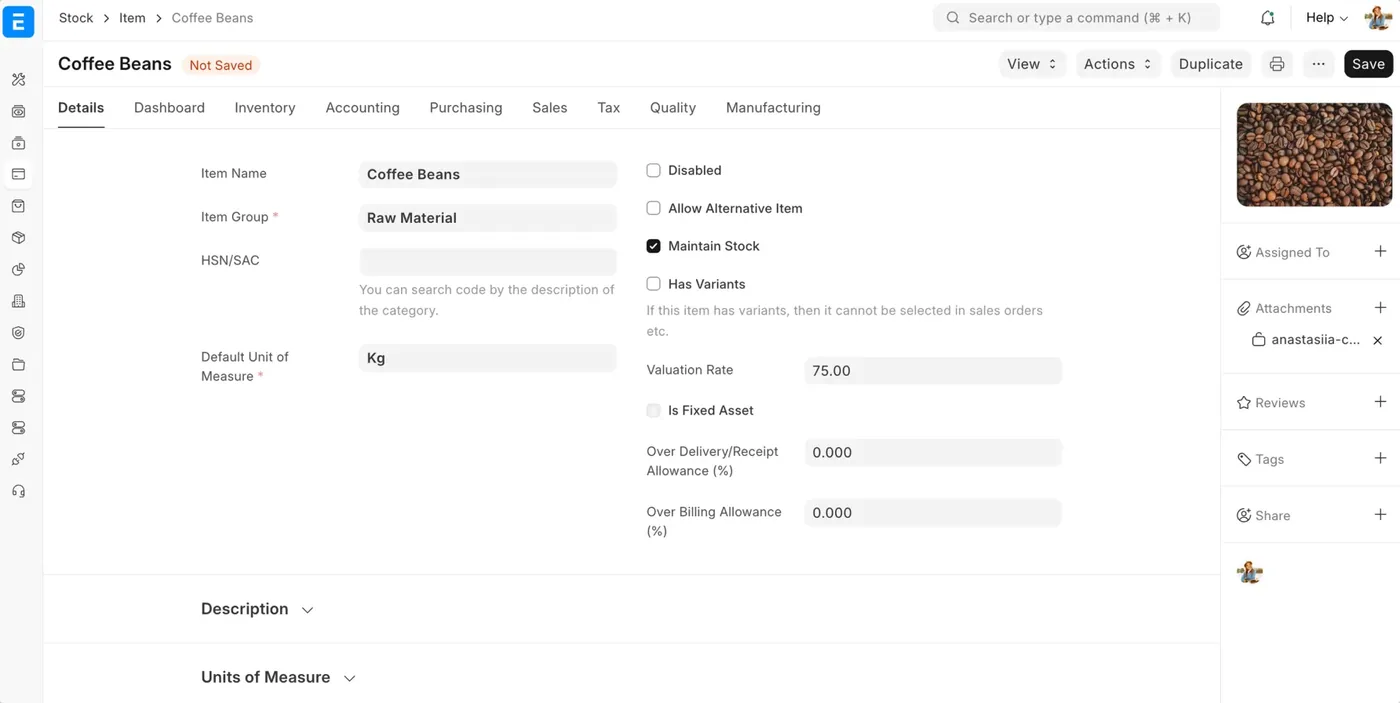
Item masters and price lists first, then warehouses and opening stock, then a period of parallel running where orders go through both the old way and the new.
Be realistic about the item master. A distribution business carrying thousands of SKUs with inconsistent naming will spend most of the project there, and it is worth doing properly: every report afterwards depends on it.
Questions
How does ERPNext handle stock across multiple warehouses?
Each warehouse holds its own stock and transfers between them are recorded as transactions, so you get a position per location and a total, with available-to-promise calculated net of what is already committed to open orders.
Can ERPNext handle distributor and dealer pricing?
Yes. Price lists apply per customer category, and pricing rules cover quantity slabs, time-bound schemes and item-specific offers, applied automatically when the order is entered.
Talk to us
Call +91 98554 31488, or use the WhatsApp button above. Tell us how many locations you hold stock in and how you answer “can we supply this today” right now.
If the answer is that one person always knows, that is the risk worth talking about first.
Tell us what breaks at month-end.
One call, your real books, no slide deck. You leave knowing what to fix first.
- Hours
- Mon-Sat, 10am-6pm IST
- Office
- Frontier Tower, 180, GT RoadMiller GanjLudhiana, Punjab
Thanks, we have it.
Your enquiry is with us. We reply within one working day, on the phone number or email you gave.