Sales · field force automation
Field sales that works where there is no signal.
Beats, check-ins, orders and stock on the phone. It works with no signal.
- The constraint
- Offline first, syncs both ways
- Reaches your ledger
- Tally over the interface, ERPNext natively
- Schemes
- Configured, not programmed
- Module set
- Scoped to your networkConfirmed against the platform, 4 Aug 2026
The constraint everything is built around
An application that assumes connectivity is not a field sales application, it is an office application somebody has installed on a phone.
The order is held on the phone and syncs when the network returns. Not before, and without the representative having to do anything about it.
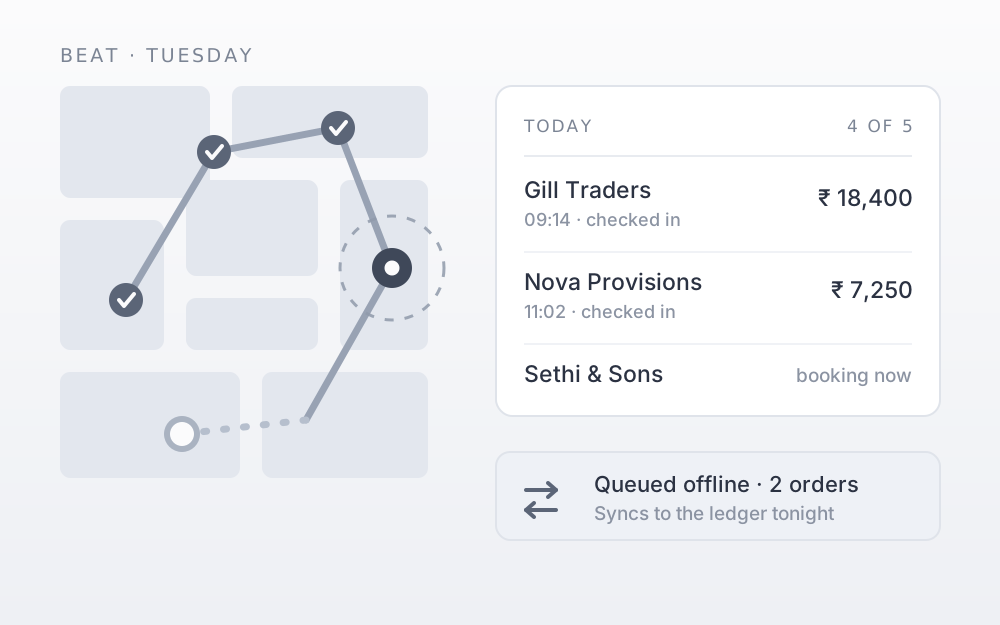
Test this before you buy anything, from us or from anybody. Put the phone in flight mode and take a full order on it, including a scheme and a stock check. An application that cannot do that will be abandoned by your field team within a month.
Beat and route planning
Which representative covers which outlets, on which day, in what order. Set centrally, visible on the phone, and measurable afterwards. How much of the planned beat was actually covered, and which outlets have not been visited in a month.
The value is not the plan. It is that the plan and what happened are in the same system, so the monthly review is a conversation about a list, not about recollection.
Attendance and visit tracking
Check-in at the outlet, geo-fenced so it has to happen there and not at the tea shop down the road, with photo verification where that is warranted.
This is the feature that causes the most argument during a rollout, so it is worth being direct about it: representatives experience it as surveillance, and a rollout that does not acknowledge that will be worked around within a fortnight. The version that succeeds is the one where the same data also removes work for them. No daily report to write in the evening, and expenses calculated from the visits already logged.
Orders, with stock checked at the point of order
The representative takes the order at the counter, on the phone, against the price list and the schemes that apply to that outlet today. Distributor stock is visible, so an order is not taken for something nobody can supply. That is the single most common cause of a cancelled line and an unhappy retailer.
Secondary sales, which is the number most businesses do not have
Primary sales, what you invoiced to your distributor, is in your books already. Secondary sales, what the distributor sold on to retailers, is the number that tells you what the market actually consumed, and most businesses in this position estimate it from primary despatches and a phone call.
The distributor side of the system captures it. What that gives you is real: how much of last month's despatch is still sitting in the channel, which SKUs move in which towns, and whether a scheme shifted volume or merely shifted it forward a month.
The gap between the two numbers is stock sitting in the channel. A business that measures only primary finds out about a slowdown one full cycle late.
Schemes and pricing, without a developer
Trade schemes change monthly and they are the thing most systems handle worst. A quantity slab, a value slab, a combination offer, a scheme for one region and not another, a scheme that runs for eleven days.
These are configured, not programmed. If changing a scheme requires a software release, schemes will end up applied by hand on a calculator at the distributor's desk, and the system will report numbers that are not what happened.
Reporting
Target against achievement by representative, by SKU and by region; coverage and productive-call rates; stock in the channel; and deviation alerts, so somebody is told when a distributor's stock stops moving, instead of discovering it at month end.
The wider module set
Depending on how your distribution actually runs, the same platform covers:
- Van sales and ready stock, where the vehicle carries stock and the invoice is raised at the outlet instead of the order being taken for later delivery.
- Merchandising, including planogram compliance: photographing the shelf and checking it against what was agreed.
- In-store promoter and retailer applications, so the retailer can place an order themselves and a promoter can report from the floor.
- Mobile point of sale.
- A dealer application and a virtual DMS, for a network where not every distributor will run a full system.
- A scheme engine covering quantity-based slabs and the shapes above, configured, not coded.
That list is the platform's full capability, confirmed against its current module set on 4 August 2026. It is not a description of what every rollout includes.Which modules you take is a scoping question, answered against your network instead of by assuming all of it. A distributor with forty retailers and a van route needs a different subset from a company running in-store promoters across modern trade.
We would rather tell you which four of these you need than sell you twelve.
It reaches your ledger
This is the section that matters, and it is the reason we sell this at all. A field sales application that does not reach your ledger produces a second set of numbers. Orders live in one system, invoices in another, and somebody reconciles them. That is exactly the duplicate-entry problem the rest of this site is about removing.
- To Tally, through Tally's own integration interfaces, so an order becomes a voucher without being typed twice.
- To ERPNext, natively, where the order, the despatch and the invoice are already one record.
A SaaS vendor selling only the field application will connect it to your accounts as a project they have no particular interest in. For us it is the same conversation as the rest of your system, because we are the ones who set that up.
What this is not right for
- Three representatives who see the same twenty customers. The overhead of running this exceeds what it saves. A phone and a shared order sheet is a defensible answer.
- A business whose real problem is that despatch is slow. Capturing orders faster makes the backlog visible sooner and nothing else.
- A business unwilling to have the conversation about tracking. It will be circumvented, and you will have paid for data that is not true.
Tell us how many outlets and how many representatives
Call +91 161 5044 180, or use the WhatsApp button above. Tell us how many outlets, how many representatives, whether you sell through distributors, and whether your books are in Tally or ERPNext.
If the honest answer is that a shared order sheet is doing the job, that is what we will say.
Tell us what breaks at month-end.
One call, your real books, no slide deck. You leave knowing what to fix first.
- Hours
- Mon-Sat, 10am-6pm IST
- Office
- Frontier Tower, 180, GT RoadMiller GanjLudhiana, Punjab
Thanks, we have it.
Your enquiry is with us. We reply within one working day, on the phone number or email you gave.